Discover recent refreshes to historic lodgings and young chefs making their mark
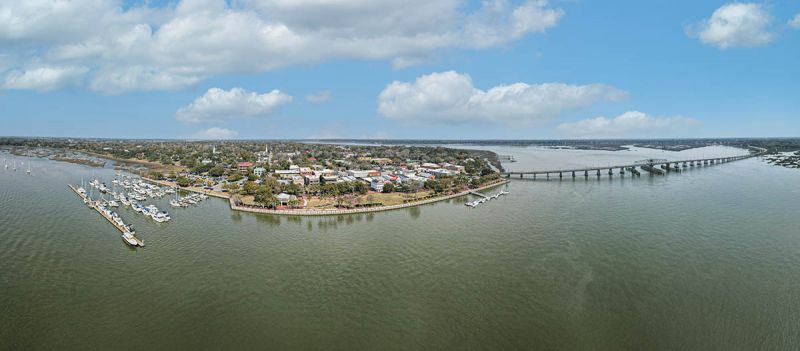


It’s not a knock on Charleston when people call Beaufort “the real Lowcountry.” Seventy miles down Savannah Highway and a jog on Route 21 to the coast, the moss hangs lower, the horizon stretches a bit farther across the marsh, and, some say, the oysters taste a little saltier. Perhaps because Beaufort is still a small town, everybody seems to know everybody. Stand outside a favorite hangout like Old Bull Tavern on a Friday night, and the parade of impromptu, spirited rendezvous continues until the last pint is poured.
Lately, I’ve noticed that as my wife, Hunter, and I get older, travel becomes a process of monitoring change. We return to cities and note the new buildings, an unexpected stoplight, a bit more traffic. But back in Beaufort on an overdue sojourn, I’m struck by how most everything looks the same. There’s a new playground and bandstand at Washington Street Park, a modern house or two under construction, but walk around the historic district, and it could be decades ago. Beaufort is a place where the good stuff sticks around.
While Greater Beaufort grew to fill the gaps around Port Royal and Lady’s Island during South Carolina’s pandemic influx, downtown remains a destination where visitors like us can be quickly pegged as foreigners from the big city up the road. Still, we’re welcomed like family, beginning with our arrival at Anchorage 1770, an 18th-century manor on Bay Street where owners Amy and Frank Lesesne have hosted travelers since 2016.
Hunter and I visited that first year, and checking in this time, I notice a photo she took on that trip hanging in the foyer. The inn has racked up nods from every publication a Southern B&B could desire a mention from, and it feels like the same stately haven. We meet our neighbors across the hall. “You came from somewhere great to somewhere great!” the wife exclaims, and I have to agree.
Before dinner at the Ribaut Social Club on Anchorage 1770’s main floor, we take a walk at dusk. There’s a film crew setting up gear at a house in The Point, around the corner from where The Big Chill shined a bright light on Beaufort back in 1983. We peek into the Beaufort Wine Bar, opened last spring. Well-lit oil paintings of Hunting Island set the scene inside, but we decide to keep walking, beckoned by the roaring fire pit outside Old Bull Tavern.
There, Gary and Ron, frequent Old Bull patrons and Navy veterans who each settled here after their final tours, welcome us to the fire and happily field questions about the latest Beaufort news. Before I can venture inside for a round of beers, Ron puts two drafts from the local Shellring Ale Works on his tab. “It’s getting busy up in Charleston,” says Gary, prompting me to praise my home city while complimenting his in the same breath. I have versions of this conversation all weekend. At McIntosh Book Shoppe, I buy a copy of The Prince of Tides, because I’ve somehow made it to 44 having read most of Pat Conroy’s lifework while never getting to his most famous.
“When are you going to slow down the growth in Charleston?” asks proprietor Miles Murdaugh (no relation to the more infamous South Carolina Murdaughs, he’s quick to clarify). We talk Conroy for a bit, eventually getting to The Water Is Wide, about the author’s time teaching elementary school on Daufuskie Island, located about 30 miles south and accessible only by boat. “I thought I lived a sheltered life growing up in Beaufort until I read that,” says Murdaugh, adding, “A sheltered life doesn’t sound too bad in today’s world.”
I agree, telling him that downtown Beaufort seems the same to me as it always has. It’s refreshing to be somewhere that appears like the pause button got pressed, letting it just exist for a while. I feel welcome everywhere I go and inspired to keep that spirit of hospitality alive in Charleston.
On Friday evening, we’re chatting with Frank Lesesne at Ribaut Social Club near a table of diners. “Not to interrupt your conversation, but are you the owner?” asks a woman, leaning over the back of her chair. “I have a piece of furniture that came out of this house.” Anchorage 1770 operated as a guest house from 1944 to 1969, and the former owner, Dreka Stokes, was a dear friend of her grandmother, she explains. “We still have her sweet roll recipe,” says Frank to the guest, who then recalls Stokes’s famous benne seed ice cream. “When I die, I’ll leave that piece of furniture to you,” she tells Lesesne.
The next morning, after Frank finishes his morning shift in the kitchen (an egg scramble with bacon and a biscuit), he checks in to make sure our next meal will be just as memorable. He sends us off to Blacksheep, a hole-in-the-wall on the north end of town that feels like a speakeasy for sandwiches. We do our best to walk off a few calories before sharing a roasted beet salad and mortadella sandwich on ciabatta.
Chef-owner Matt Wallace partnered with general manager Krista Duffy to open Blacksheep in spring 2020, barely surviving the pandemic shutdown. “Just as money was running out, they announced we could open at half capacity,” says Duffy. “Beaufort is such a great community, and it ended up working in our favor.”
Lunch is so fantastic that Hunter and I ask Duffy to choose our next meal. She recommends Beedos, a burger joint on St. Helena Island, and Locals Raw Bar. It’s a beautiful sunny afternoon, so we take the half-hour drive out to Hunting Island. At the state park’s south end, just across the bridge from Fripp Island, we walk through the maritime forest out onto a boneyard beach with an edge-of-the-world aura, following a tidal creek north as dusk sets in. I question whether I’ve ever been here before, yet I know I have. Then, I realize that for years, we’ve gone to the north end of the island. I’m seeing this section for the first time since Hurricane Matthew in 2016. Unlike downtown Beaufort, there’s no permanence on a barrier island—change is the constant.
After a magical, moonlit return hike through the woods, we drive to Beedos, a roadside joint helmed by local couple, Melissa and Brian Wuttke, since 2020. Brian left his post as executive chef at Saltus, Beaufort’s enduring fine-dining restaurant, to open the breakfast-and-burger café. This counter-serve is far from white tablecloth, and it’s perfect.
We indulge in a hand-ground double smashburger with griddled onions on a house-made potato bun, plus a platter of buttermilk fried shrimp. I’m stuffed when we stop into The Fillin’ Station for a nightcap, taking in the stars’ reflection over the water while the scene around the pool table gets incrementally louder inside. It’s Saturday night in Beaufort, and crossing the bridge back to downtown, there’s nowhere I’d rather be.
We’d planned to head home Sunday, but when “Camp Grandparents” offered to extend our kids’ stay a night, we took the opportunity to visit the Reconstruction Era National Historical Park, established in downtown Beaufort in 2017 by the National Park Service. A no-fee visitor center includes museum exhibits and free walking tours.
Park ranger Dr. Chanda Powell explains how Beaufort became a Union stronghold early in the Civil War. After hearing the cannon fire of the invading ships in St. Helena Sound, the roughly 2,000 white inhabitants of the city quickly fled to Savannah, Charleston, and further afield. “They called it ‘The Great Skedaddle,’” says Powell of the 1861 exodus. But more than 10,000 formerly enslaved people remained, prompting the federal government to initiate the Port Royal Experiment, a project that included recruiting teachers to educate the soon-to-be-free Black residents. “Most American history textbooks tell the story from 1865 to 1877, but Reconstruction started here in 1862,” Powell explains, emphasizing that the model used across the South after the war ended was underway years earlier in Beaufort.
After the tour, we drive to the former site of Camp Saxton on the Beaufort River, where the Emancipation Proclamation was read in a grove of still-standing live oaks in 1863. Throughout the war, many enslaved people escaped to Beaufort, and Port Royal Island served as an island of freedom years before the Civil War ended.
Inspired and informed, we head a few miles further to Shellring Ale Works, a craft brewery opened in 2022 with a waterfront view of the Broad River. A bluegrass band covers Grateful Dead tunes amid towering steel fermenters while we sip on a “Cluster” lager imbued with brine from Braden Oyster Farm’s local bivalves. It’s an idyllic evening as we swing from an oak limb and watch the sun set over Parris Island. We’re tempted to walk next door to Fishcamp for more fried seafood but decide to stick with Krista from Blacksheep’s itinerary and drive back to Lady’s Island for dinner at Locals Raw Bar.
The sterile shopping center Google Maps leads us to belies the beauty behind the open kitchen, where chef Hunter Cozart and his inspired crew work their magic. We sit at the bar to take it in—local snapper sushi rolled to order, buttered lobster rolls, and a bowl of ramen that teeters on best ever territory. Cozart starts the broth on Monday (“We make stock out of stock—trotters, tailbones—and roast that down and let it run for two days”), before melding it with leeks, heart of ginger, shiitakes, and a healthy dollop of braised oxtail so that it’s ready for Thursday service. The depth of flavor is divine, and its ingredients, like the full menu, change weekly with the seasons.
After pulling Cozart from his kitchen duties for far too long, drawing out the secrets behind the puffed Charleston Gold rice on his chocolate torte (“It’s got to be overcooked perfectly—when you can smash it on the roof of your tongue”), we once again cross the bridge, this time to settle in for a night at the century-old Beaufort Inn that was recently reinvigorated by Charlestowne Hotels management. The 48-room establishment spans a city block, including the original inn, historic cottages, and new suites that match the aesthetic, all built around a series of courtyards with string lights, fire pits, and fountains. My head hits the plush pillow, and I don’t wake up until morning light hits my eyes.
We have one more stop to make on Monday morning. Walking along Bay Street on Saturday, we’d explored art galleries and craft shops, but I’d left the Rhett Gallery without speaking with the owner about his collections of maps, antique guns, and vintage guitars and amps. William Means Rhett III is the fifth of six generations of artists to fill their family gallery with oil paintings and sculptures inspired by the Lowcountry beauty around them. The space features soaring marsh scenes, elaborately carved ducks, and centuries-old maps, including a hand-drawn series showing the oyster beds along the South Carolina coast.
I play a Gibson Nighthawk through a Goodsell tube amp—the real reason I wanted to come back—before asking about the picture of a group of children on the wall, framed with Forrest Gump paraphernalia from the movie’s filming here in 1993. Rhett made his Hollywood debut as one of the boys on Forrest’s school bus. He recalls being dressed in corduroys and long sleeves and forced to sit in the bus’s stale air in 115-degree August heat. “They knew the local kids couldn’t act, so they wanted to show genuine misery,” he recalls. “It’s a wonderful memory of a bad experience.”
The next day, Rhett was offered a part in another scene where kids chase Forrest on a bicycle. “I said, ‘I’ve got a dog and a boat, and a house with air conditioning. I’m going home,’” he laughs. And that sums up Beaufort. It doesn’t have everything in the world, but it has everything you need, if you like the kind of things that Lowcountry people like. I sure do, and I’ll be back soon.